

Urbio in PME Magazine: How AI is Accelerating Europe's District Heating Transition
Urbio is proud to be featured in the May 2026 edition of PME Magazine, one of Switzerland’s premier business publications. The special feature, which explores the rapid evolution of the Swiss proptech ecosystem, highlights how Urbio's generative design platform is transforming the way energy providers approach complex urban infrastructure—turning traditionally slow planning processes into a rapid catalyst for Europe's energy transition.
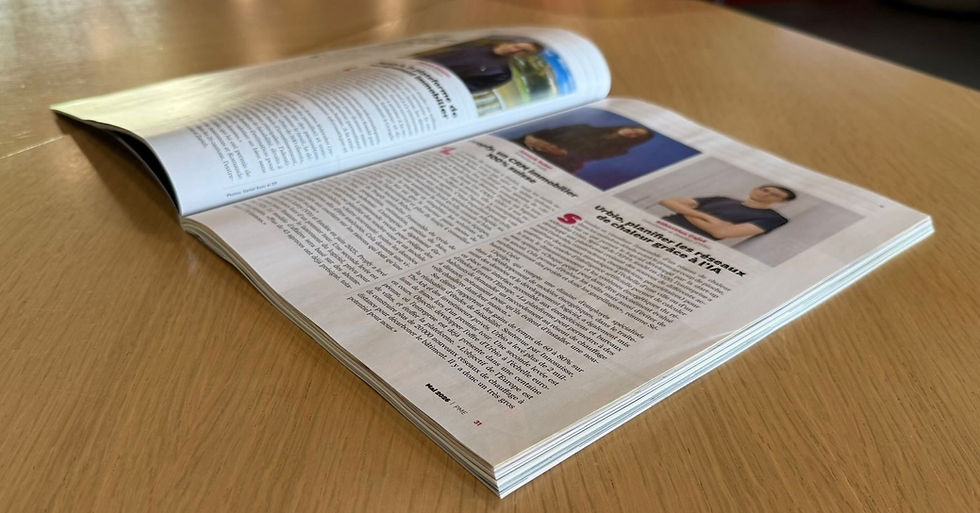
In a well-researched special edition, PME Magazine explores the broad transformations reshaping the building and real estate sectors. Covering facets ranging from artificial intelligence in property management to smart construction tech, the dossier also dives into the critical topic of district heating networks. The publication explores the overarching benefits, the operational complexities, and the emerging opportunities to decarbonize by reusing excess energy, such as data center waste heat.Setting the stage for the industry's technological shift, the dossier notes:
"District heating networks and local electrical communities are multiplying, resulting in energy and cost savings, but also technical and organizational challenges that remain to be overcome to anchor these new schemes sustainably in practice. To meet these technical and ecological challenges, numerous start-ups have established themselves in the so-called proptech sector, particularly in the Lake Geneva region."
– PME Magazine
Recognized for its focus on digital infrastructure design, Urbio was interviewed as part of this edition to shed light on how modern district heating network planning is directly addressing these technical hurdles.
Tackling a Multi-Million Euro Infrastructure Challenge
Across Europe, the push for sustainable heating is accelerating under the pressure of ambitious climate goals. The continent aims to build over 20,000 new thermal networks to effectively decarbonize urban buildings. However, as PME Magazine points out, the investment decisions behind these grids often run into tens of millions.
Historically, preliminary modeling for these massive projects has remained underdeveloped, relying on manual processes that are both time-consuming and prone to costly oversizing. In its feature, PME highlights how the integration of advanced data processing and artificial intelligence into urban development is shifting the industry toward highly informed decision-making, significantly reducing the consumption of material and financial resources.
AI-Driven Digital Twins
Founded as a spin-off from the Swiss Federal Institute of Technology (EPFL), Urbio was built specifically to solve the complex engineering bottlenecks associated with thermal networks.
The publication details how the software platform aggregates diverse data sources from public authorities, builders, energy providers, and property owners to generate comprehensive digital twins at the scale of an entire city or neighborhood. On top of this spatial data, an advanced AI layer simulates and visualizes the infrastructure down to the smallest detail before a single trench is dug.
"Every project can therefore be precisely evaluated upstream," explained Sébastien Cajot, Bilanz 2026 Digital Shaper, co-founder and CEO of Urbio, to PME Magazine. "This makes it possible to evaluate costs, but also to avoid oversizing projects and therefore waste."
"Urbio makes it possible to evaluate costs, but also to avoid oversizing projects and therefore waste"
– Sébastien Cajot, Co-founder & CEO, Urbio
Redefining Speed and Precision for Energy Planners
Developing an optimal heating grid requires balancing complex variables: routing, pipe sizing, and integrating the right energy generation systems. For energy consultants and techno-commercial utility teams, conducting these preliminary assessments has traditionally taken weeks.
By automating the heavy lifting of spatial and energetic calculations, the platform empowers users to design optimal networks in a fraction of the time. In fact, as highlighted by PME, active users of Urbio's software for district heating planning report significant decreases in time spent on feasibility studies.
The magazine also underscored the platform's collaborative nature. It features interfaces that allow residents to proactively request connections to a thermal network, helping them avoid the installation of individual fossil-fuel boilers and accelerating customer acquisition for utilities.
Fueling European Expansion
The urgent need for robust district heating network planning tools has fueled rapid adoption, with Urbio already active in approximately 200 cities across Europe.
Backed by Innosuisse, The Ark, and private investors, Urbio successfully raised over 2 million CHF in its initial funding round. The company is currently scaling its operations across the European market, making it's software available to utilities and consulting firms everywhere looking to streamline their district heating feasibility studies.
👉 Read the full original article: Proptech Suisse: IA et immobilier en pleine révolution, PME Magazine, Erik Freudenreich, Julien Crevoisier, Gabriel Sigrist, Blandine Guignier, 21/05/2026.
About PME Magazine
PME Magazine is a leading Swiss monthly business publication dedicated to entrepreneurs, executives, and leaders of small and medium-sized enterprises (SMEs). It provides in-depth analysis, economic news, and strategic insights on innovation, technology, and the overarching business trends shaping the Swiss market.
About Urbio
Urbio is an impact-driven software company specialized in district heating planning, artificial intelligence and data. Founded in 2020, Urbio is a spinoff from climate-tech university EPFL in the heart of the Swiss Alps.